Level 7 – AI Market(subscribers)
(The Race for Leadership: Internal or External Growth?)

Inspired by the BFM game from summer 2025, this session takes you into the world of artificial intelligence. The world’s leading internet companies have experienced phenomenal growth over the past five years, and their market capitalization now exceeds the GDP of many countries.
It is becoming increasingly clear that artificial intelligence is revolutionizing the internet search market as well as the social media market. The internet was able to grow very quickly by capturing advertising, where its market share is very high. Today, overall growth is slowing, making the competition more intense.

The Economic Context:
This chessboard starts in 2025.
We have designed a strategic segmentation for you where eight competitors are engaged in fierce competition across eight niches of the internet world. Reality is obviously more complex, and this is only a simulation for educational purposes, but this chessboard still allows you to consider the upheavals that are likely to occur.
Each of the eight niches was founded by a well-established company. The competitive dynamic shifts the balance of power and allows newcomers to make a strong entry into niches adjacent to their original niche. Proper resource allocation is a vital decision: choosing too small a time slot limits your long-term potential, while spreading yourself too thin can lose everything. Finding the right balance is more crucial than ever.
As with the other game sessions, don’t forget the lesson and in particular the one on substitutions (chapter 4) and the one on exit strategies (chapter 8).

The competitive landscape at the start of the game:
This new competitive landscape comprises eight competitors and eight niches:
- 5 software niches that have become “traditional” stemming from previous Internet revolutions:
- Search (traditional search engines)
- Other software (consumer software, operating systems, etc.)
- Social networks
- Cloud (data centers)
- Streaming (video-on-demand platforms)
- 1 physical product niche:
- Consumer hardware (phones, virtual reality headsets, smart glasses, etc.)
- 2 new high-growth niches linked to the explosion of generative artificial intelligence:
- AI bots (chatbots)
- AI agents (AI-based agents capable of autonomously performing complex tasks).
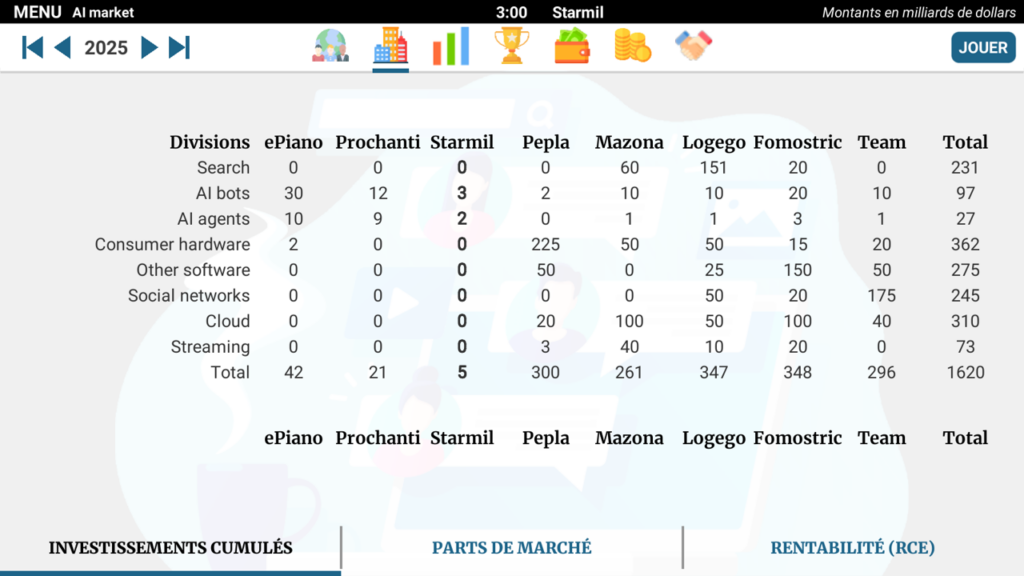
AI market – initial assets of the eight competitors
(fictitious companies and data)
Your Company:
In this session, you’ll be guiding the strategic decisions of Starmil, a young unicorn trying to carve out a niche among the internet giants who already boast massive cash flows from their leadership in traditional sectors (search engines, operating systems, social networks, online services, etc.).
Starmil operates in the two rapidly growing niches of generative artificial intelligence (AI bots and AI agents), but has a very small market share and limited financial resources compared to its direct competitors.
Will you be able to find your place in this new Wild West?
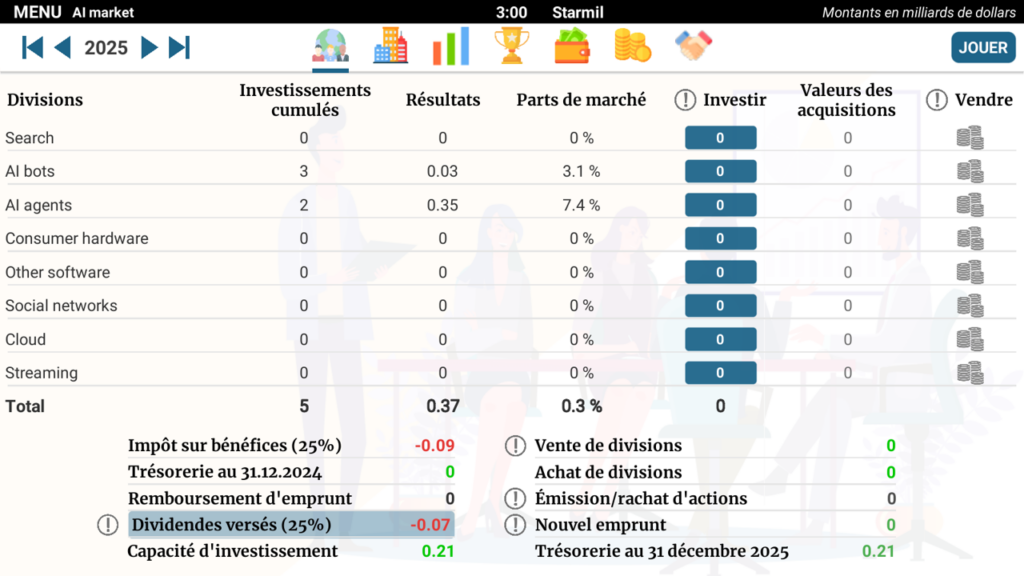
AI market – board of directors of Starmil company
(fictitious companies and data)
Main game parameters:
Games are shorter than usual: due to strong business growth, the time horizon is ten years. Each year in the game lasts 3 minutes, so a game lasts a maximum of 30 minutes. You can speed up time by clicking “Skip the year”.
Strategic Action Levers
You can use all the usual strategic action levers:
-
- Borrow from your bank (with a fixed repayment schedule spread over 5 years)
- Issue new shares
- Repurchase your shares
- Adjust the dividend rate paid annually to your shareholders.
The major new feature of this session is that you will also have access to a new lever for action: external growth, which gives you the possibility to:
-
-
- to auction off your least profitable or least strategic divisions,
- to buy divisions put up for sale by your competitors.
-
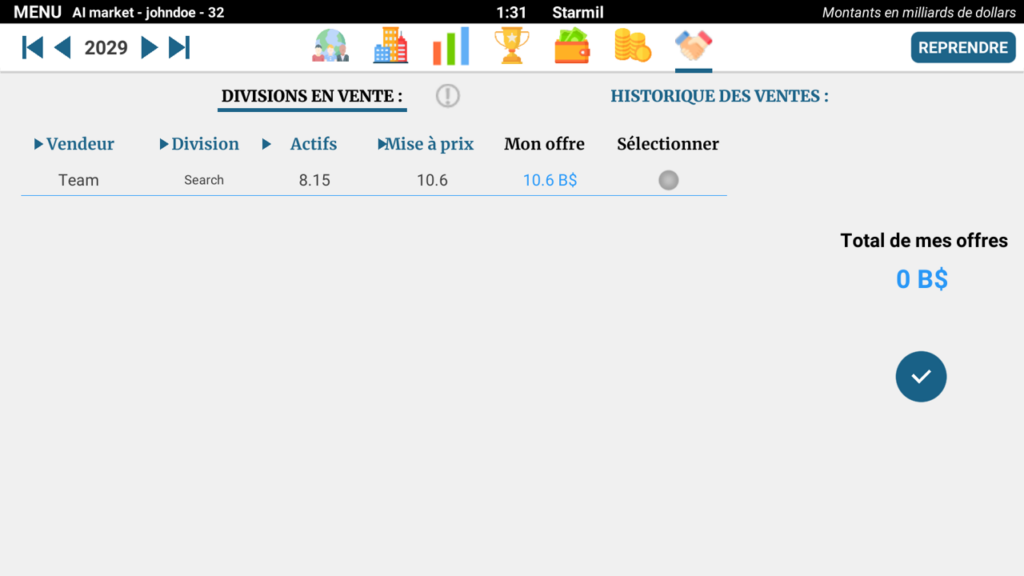
Sales are subject to an auction. The selling companies set a starting price, and interested competitors make an offer, which is evaluated the following year.
A purchased division is incorporated into the acquiring company’s equivalent division at the pre-sale asset value.
The seller then receives the amount offered by the buyer.
Good luck!
.
To start a new game:
. If you are on a computer: Click here
. If you are on a smartphone or tablet, download the “Strathena” mobile app from Google Play or the App Store.
