Links between the game and the videos
You will discover many links to the course as you progress through the game sessions.
For example, as you saw in Chapter 1, while the value of market share is fundamental, profitability in the service industry is often a function of the local market share. The larger the local market share, the higher the profitability, and vice versa. Remember the waterlily strategy!
Don’t hesitate to also review Chapter 2 of the course, which details winning financial strategies for combining rapid growth and profitability by leveraging dividend yields and strategic debt.
Present in all game sessions, the regulator constantly monitors the competitive landscape and can prevent a competitor from investing if their market share in a market segment risks giving them an overly dominant position. Their role in the real economy is presented in this bonus video.
To rank among the best players, you will need to constantly compare your competitive situation with that of your rivals, using the principles of the BCG Matrix presented in Chapter 10 (available to subscribers only).

The advanced game sessions (available to subscribers only) introduce the following concepts:
. Life cycles and substitution are integrated into the game starting in Session 3 (Food Distribution), as defined in Chapter 4.
Issures and Share buybacks can be used as strategic levers starting in Session 5 (Automotive) and are presented in the two videos in Chapter 11 (Growing Through the Stock Market).
External growth strategies in play in Session 7 (AI Market) are described in the video in Chapter 8.
The difficulty level of each game session is linked to:
- your competitive and financial situation at the start of the game
- the complexity of the competitive landscape, which is proportional to the number of competitors and market segments to analyze
- and the number of strategic levers at your disposal.
The table below summarizes these last two points:
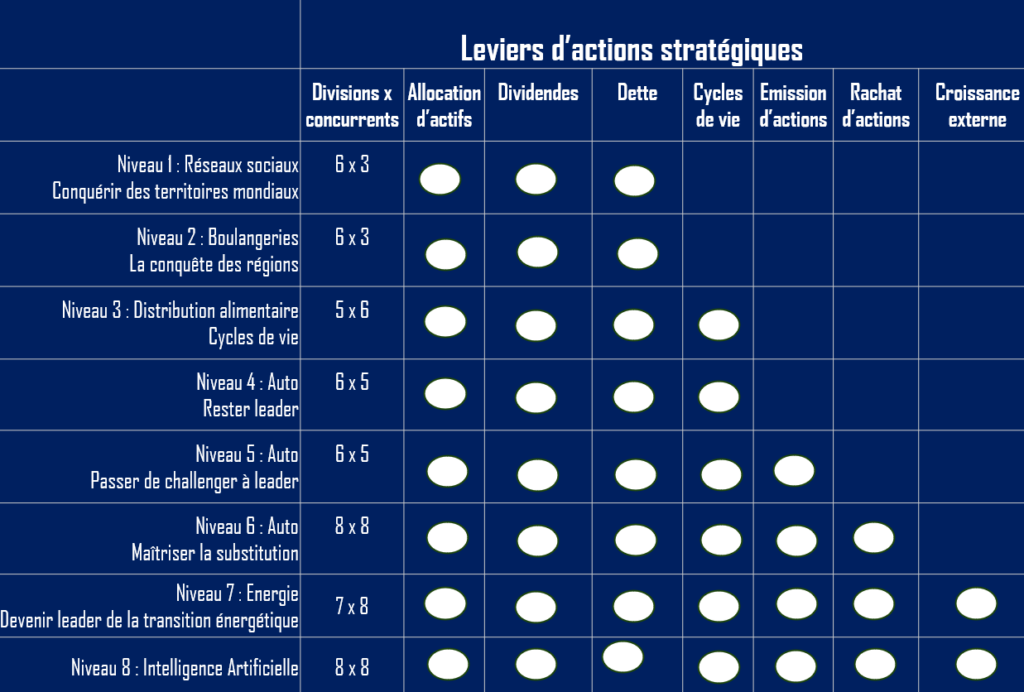
Main strategic action levers
